Construction Loan Lenders: Who Actually Funds New Builds (And Why It’s Different From Buying)

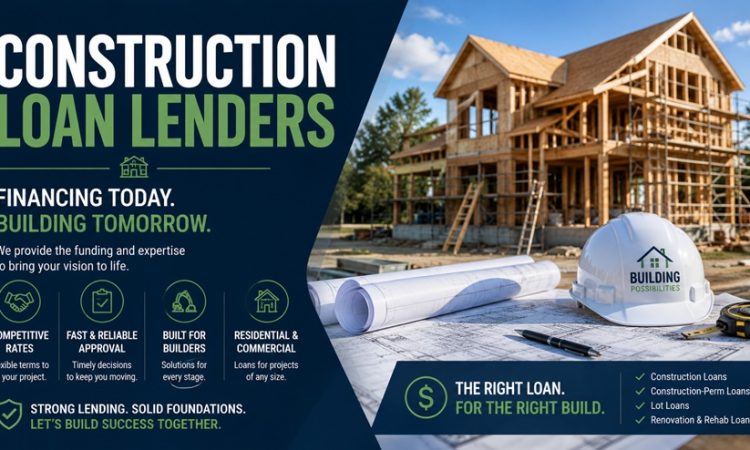
Construction loan lenders fall into three main categories: community banks and credit unions (which dominate the market because they hold loans on their own books), specialty construction lenders (focused exclusively on new builds and rehabs), and a handful of larger national banks with construction divisions. The Big 4 national banks generally do less construction lending than people expect — the work concentrates in regional and community institutions because the loans are more operationally complex than standard mortgages.
Construction loans differ from regular mortgages in three significant ways: they’re short-term (typically 12–18 months during construction), they fund in draws rather than as a lump sum, and they convert into a permanent mortgage upon completion (called construction-to-permanent or “C2P” loans). Because of this complexity, construction loan rates run 1–2 percentage points above standard mortgage rates, and underwriting is stricter.
The Three Main Lender Types
| Lender Type | Typical Loan Size | Strength | Weakness |
|---|---|---|---|
| Community banks/credit unions | $200K–$2M | Local relationships, builder familiarity, portfolio flexibility | Limited geography, slower decisions |
| Specialty construction lenders | $300K–$5M+ | Construction-specific expertise, faster builder relationships | Higher rates, less flexibility |
| Large national banks | $500K+ (often jumbo) | Brand recognition, broader product menu | Less construction focus, stricter rules |
For most owner-occupied builds in the $300K–$800K range, community banks and credit unions are the best first call. They’ve built their construction lending models around exactly that price point.
How Construction Loans Actually Work
A typical construction loan has four phases:
1. Approval and loan setup. Borrower qualifies, lender approves, builder is vetted, construction budget is finalized. Closing happens before construction begins.
2. Construction phase (12–18 months). Funds are released in “draws” tied to construction milestones — foundation poured, framing complete, mechanical rough-ins done. The borrower pays interest only on what’s been drawn, not the full loan amount.
3. Conversion to permanent mortgage. Once construction is complete and the home passes final inspection, the loan converts to a standard 15- or 30-year mortgage. With a true construction-to-permanent loan, there’s only one closing (saves thousands in fees).
4. Permanent mortgage phase. From completion forward, you have a normal mortgage with principal and interest payments.
The draw process is one of the most underappreciated parts. Each draw requires inspections and lender approval before funds release, which can create timing pressure with contractors expecting prompt payment.
What Construction Lenders Require
| Documentation | Why |
|---|---|
| Builder information and license | Confidence in the contractor |
| Construction contract | Defines scope, cost, timeline |
| Detailed budget | Line-item breakdown of costs |
| Architectural plans | What’s being built |
| Soil tests, surveys, permits | Risk verification |
| Larger down payment (typically 20–25%) | Reduces lender risk during construction |
| Higher credit score (often 680+) | Compensates for construction risk |
The 20–25% down payment is meaningful. Many buyers comfortable buying an existing home at 5–10% down find construction loans require significantly more cash upfront.
Rates and Costs
Construction loan rates typically include two components:
| Phase | Typical Rate |
|---|---|
| Construction phase | Prime + 1–2% (variable) |
| Permanent loan after conversion | Locks at market rate at closing |
The construction-phase rate is often variable, tied to the prime rate, which is one reason builders aim to keep timelines short. Closing costs run 2–5% of the loan amount; construction-to-permanent loans avoid a second closing, saving $3,000–$7,000.
Where to Start Your Search
- Your local credit union — if you’re a member; relationship pricing often beats banks
- Community banks in your area — especially ones known for working with local builders
- Specialty construction lenders — firms with construction-specific divisions
- National banks — only if your loan size or location requires them
The single best signal of a good construction lender is the answer to “how many construction loans does your branch close per year?” If the answer is “a handful,” look elsewhere — you want a lender that does this routinely.
Common Pitfalls
Underestimating the budget. Construction routinely runs 10–20% over the initial estimate. Loans built tight to the original budget end up requiring change orders or additional funding.
Builder problems. A delayed builder can stretch the construction phase, accruing more interest during the variable-rate period. Vet your builder as carefully as your lender.
Permanent rate uncertainty. If your construction-to-permanent loan doesn’t lock the permanent rate at initial closing, you bear interest rate risk during construction. Ask explicitly.
Insufficient down payment. Many buyers underestimate the 20–25% requirement and end up unable to close.
Bottom Line
Construction loan lenders are mostly community banks, credit unions, and specialty firms — not the household-name national banks. Start with local institutions where you already have relationships. Bring a strong builder, a buffered budget, and 20–25% down. The process is more involved than a standard mortgage, but for a custom build, there’s no alternative path. Done right, a construction-to-permanent loan gets you from groundbreaking to a 30-year mortgage with one closing.